2010年1月29日 星期五

Objective Sculptures(Jan16 2010)


ii. Art theory (on objective sculptures: mostly statues of human figures)
1.For what purpose was this object made? (represent a deity? A human being as a deity? )
2.Portrait? (If so à accessories? A strong sense of an individual? )
3.Pose
4.drapery
5.Medium, techniques
6.Size
7.What kind of volume? (Geometric? Irregular?)
8.What’s the original site? (public square? Pediment?)
9.Is the base part of the work?
10.Where is the best place to stand in order to experience the work?
--------------------
ii. Art theory (on objective sculptures)
1.For what purpose was this object made?
What does the highly ordered, symmetrical form of the King suggest about the man?
Egyptian, King chefren, ca. 2500BC. 5’6”
now at Egyptian Museum, Cairo

ii. Art theory (on objective sculptures)
2. Portrait?
-A strong sense of an individual? Or just of a type?
-In the tradition of idealizing, commemorative images of elders usually show them in the prime of life.


ii. Art theory (on objective sculptures)
-3. Pose: what does the pose imply? Effort? Rest? Arrested motion? Authority?
-Are certain bodily features or forms distorted? Why?

Lincoln Memorial: sitting, face: weariness, tired


•Jefferson Memorial: standing, one foot slightly advanced, fainly smiling faceàsuggest confidence & action
ii. Art theory (on objective sculptures)
4.drapery:
•is it independent of the body?
•Does it express or diminish the volumes (enclosed space e.g. knees, breasts) that it covers?
•Does it indicate bodily motion or an independent harmony?


ii. Art theory (on objective sculptures)
5. Medium, techniques:
e.g. welded iron suggested heavy industry, in contrast with bronze and marble, which suggested nobility
e.g. Rodin’s walking man: bulit up by modeling clay and then cast in bronzeà recalls in every square inch of the light-catching surface a sense of the energy that’s expressed by the figure
e.g. King Chefren: cut away from the block that did not look like him: solidity of stone

ii. Art theory (on objective sculptures)
Size: larger than life à suggest?


ii. Art theory (on objective sculptures)
7. Geometric? Irregular?
King Chefren has a closed formà
stability and permanence

Mercury has an open form
“Mercury” (1580) 69” By Giovanni da Bologna

ii. Art theory (on objective sculptures)
1.What’s the original site? (public square? Pediment?)
2.Is the base part of the work?
3.Where is the best place to stand in order to experience the work?
“The Bus Riders” 1964 by George Segal 69” X40”X76”
àSite-specific art pieces responding to current issues

Sculptures (7 Jan 2010)

Techniques involved:

•Carving(subtractive)
•Modeling
•Assembling (additive)
•Casting
-----------------------------------
Different types:
•freestanding sculpture
•relief


freestanding sculpture
“Dicus-thrower” by Myron BCE 449-334
(relief):
-------------------------------------------

Classical Greek Sculpture:
During the Classical period, Greek sculptors focused their energies on naturalizing effects on the human figure.
The beginning of the Modern period of Sculpture--- Auguste Rodin

Rodin's main contributions:
1.Abandoned the idea of making a work solely for commission
2.Used fragments as a definitive art form
3.Created a fashionable theme: speed with the torso (body )


1.Abandoned the idea of making a work solely for commission à sculptures became more personal to the maker
Craft or art???


The Gates of Hell, 1880-1917

2. Used fragments as a definitive art form


Hand of the Devil
The Secret, 1910

3.Created a fashionable theme: speed with the torso (body)
Walking Man, c. 1900

-------------------------------------------
“Ready-made” --- Duchamp
•The concept of “ready-made” is very powerful in modern period of art, because it helps break the tradition and pushes artists to try more different medium.
Marcel Duchamp (28 July 1887 - 2 October 1968) was a French painter and theorist, a major proponent of DADA, and one of the most influential figures of avant-garde 20th-century art
Nude Descending A Staircase (1912)
Fountain is perhaps best known for the huge historical scandal it sparked in the art world: the Richard Mutt Case.
It was refused entry to the first exhibition of the Society of Independent Artists at the Grand Central Palace in April 1917.
Fountain, 1917
The Richard Mutt Case:
They say any artist who pays six dollars may exhibit.Mr. Richard Mutt sent in a fountain. Without discussion, this object disappeared and was never exhibited.What were the grounds for refusing Mr Mutt's fountain:-1. Some contended it was immoral, vulgar.2. Others that is was plagiarism, a plain piece of plumbing.Now Mr Mutt's fountain is not immoral, that is absurd, no more than a bathtub is absurd. It is a fixture which you see every day in plumbers' show windows.

Whether Mr Mutt made the fountain with his own hands or not has no importance. He CHOSE it. He took an article of life, placed it so that its useful significance disappeared under the new title and point of view - created a new thought for that object.
http://arthist.binghamton.edu/duchamp/fountain.html

-------------------------------------------------------------------------------
Other Conceptual Artworks:

Piero Manzoni – for him, individuality itself became art in real time, expressing “being and living.’’


Much of conceptual art focused on the artistic experience itself and its theoretical components


------------------------------------------------------
Acconci explored the artist-viewer relationship in this piece, by randomly selecting individuals on the street in New york and following them until they went into someplace that wasn’t public.
“I was a passive receiver of someone’s time and space.”


Vito Acconci, Following Piece, 1969


------------------------------------------------------------
Site-Specific Art

creating an art work that
•is integrated with its surroundings
•explores its relationship to its location
(e.g. indoors or outdoor, on a street, in a living room etc.)

What is it?


It is a castle called Reichstag in Germany being wrapped by the artists, Christo and Jeanne-Claude.


Wrapped Reichstag, Berlin, 1971-95,Christo and Jeanne-Claude


http://www.christojeanneclaude.net/wr.html

-----------------------------
What is it?


It is an art piece called “Where We Are Now (Who Are We Anyway?)” by Vito Acconci done in New York in 1978.


----------------------------
Wow…
Who is it?


Untitled. by Robert Gober (1989-90) Material: Wax, cotton, leather, human hair, and wood, Size: 28.9 x 19.7 x 50.8 cm

2009年12月11日 星期五

Art History 7: Greek Art VI (Hellenistic period)

-Alexander the Great died as the Hellenistic period started
-heroic city-states passed away, and the power of Athens also passed away
-more into a cosmopolitan (citizen of the world ) civilization
-sculptors played with traditional subjects in new ways, and also portray new subject matters

______________________________
Nike alighting on a warship from Samothrace, Greece, ca 190 BCE. Marble. 8'1"high.
-wings still beating
-winds sweeps her drapery
-placed in a fountain of splashing water -->heightened the dramatic visual effect
-water: the sense of lightness and movement
-Hellenistic statues: interact with the environment, as living, breathing, emotive. (Classical statues: ideally proportioned, and more self-contained)

____________________________

by Alexandros of Antioch-on-the-Meander, Aphrodite (Venus de Milo) from Melos, Greece ca 150-125BCE. Marble 6'7"high.
(right: restored view)

-originally: her left hand holds the apple Paris awarded her when he judged her the most beautiful goddess, and right hand may have lightly grasped the edge of her drapery near the left hip
-displaying eroticism
-slipping garment to tease the viewers


______________________
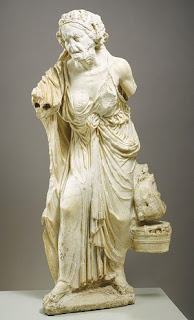
Old Market Women, ca 150-100BCE. Marble 4'1/2"high.


-realism in the Hellenistic art
-lowest class (never was a suitable subject in the earlier Greek statuary
-different ethnic types (more foreigners in Greek, more cosmopolitan)


Art History 6: Greek Art IV (Late Classical Period)

Characteristics of Greek Art in this late classical period (4th century BCE):

-in the Classical period(5th century BCE): they believed that rational human beings could impose order on their environment, could create "prefect" statues and discover the "correct" math formulas for constructing temples

-BUT Wars and unstable political environment in the last Classical period affected the art Greeks produced: an end to the idealism of the previous century
-Here, Greeks art focused more on the individual and on the real world of appearances rather than on the community and the ideal world of perfect beings

____________________________
by Praxiteles, "Aphrodite of Knidos" Roman marble copy of an original of ca 350-340 BCE 6'8"high.

-Praxiteles: a famous sculptor in the 4th century BCE
-Aphrodite of Knidos: represent the goddess of love completely nude
-Female nudity was rare in earlier Greek art (only on vases designed for household use, and only for slave girls, but not noblewomen or goddesses)
-the goddess engages in a trivial act of everyday life: removing garment and draped it down to a water pitcher, so to prepare for her bath
-though sensuous, but not erotic (right hand covers her pelvis)

_____________________


- by Lysippos, Apoxyomenos. Roman marble copy of a bronze original of ca 330 BCE. 6'9" high

-new proportion system: thiner
-not as balanced
-break down the dominance of the frontal view: with his right arm forward (encourage multiple angles in view)

Art History5: Greek Art III (High Classical Period-- Parthenon)

Parthenon

-ideal solution to the Greek architect's quest for perfect proportions in Doric temple design

-short ends have 8 columns and long sides have 17 (can be expressed algeraically as x=2y+1 -- 17=2(8) +1 )

-with harmonious design and mathematical precision of the sizes

-but also have irregularity: for examples:


1. the stylobate (the base) curves upward at the center on the sides and both facades


2.the columns lean inward slightly


--->contrapposto (shifting of weight) in architecture


East and West Pediments


left hand side of the East Pediment:
the horses of Helios (the Sun) emerge from the pediment's floor, suggesting the sun rising above the horizon at dawn.


right hand side of the east pediment: the statues conform perfrectly to the slope, and the thin and heavy folds of the garments reveal the body forms nicely

Art History 2: Egyptian Art


Right: Palette of King Narmer

(left: back; right: front)

from Hierakonpolis, Egypt, Predynastic, ca. 3000-2920 BCE. Slate, 2'1"hight.


-earliest preserved labeled historical reliefs
-a utilitarian object used to prepare eye makeup
-commenmorate the unification of Upper and Lower Egypt. (signified by the two interwined necks of the animals)
-Narmer, the largest figure, defeating a foe on one side, and on the other survys the beheaded enemy
___________________________


Great Sphinx:


-the largest statue in the Near East
-carved out of stone directly
-represents a pharaoh
-associated with the sun god
-combination of human intelleigence with the immense strength and authorith of the king of beasts
__________________________


The Papyrus Scroll of Hu-nefer's Last Judgment.

The book of the Dead contained spells and prayers. This scroll depicts the weighing of Hu-Nefer's heart against Maat's feather before the deceased can be brought before Osiris, god of the Underworld.